
You stand in the kitchen, and you know, logically, it’s not that bad. A few dishes, some mail, a load of laundry that needs switching. But your brain doesn’t register “a few small tasks.” It registers one enormous, undifferentiated wall, and you end up standing there doing nothing, then feeling worse about doing nothing than you would have felt just doing the dishes. If you’ve been told to “just make a schedule” or “just do a little each day” and it’s never once worked, you’re not bad at cleaning. You’re being handed advice built for a brain that isn’t yours.
Here’s the short version: ADHD makes cleaning harder in specific, well-documented ways, mainly around starting tasks and sustaining attention through boring ones, not because of a lack of caring or trying. The fix isn’t more discipline. It’s restructuring the task itself into something your brain can actually start and finish. Below is the science behind why this is hard, the strategies shown to help, and a full printable checklist built around micro-tasks instead of vague chore categories.
The Myth: You Just Need a Better System or More Willpower
Most cleaning advice assumes a brain that can look at “clean the kitchen,” break it into steps automatically, start without a push, and keep going once the novelty wears off. That’s a lot of invisible executive-function work happening before a single dish gets washed. According to George Sachs, PsyD, a clinical psychologist specializing in ADHD, the issue is that ADHD affects the brain’s “management systems” that control planning, prioritization, task initiation, and sustained focus. A simple instruction like “clean the kitchen” has no built-in starting point, which is exactly why it stalls before it begins. The system isn’t broken. The instructions are missing a step most people don’t realize they need.
Why This Is Genuinely Harder, Not Just Unpleasant
A few things are happening at once, and understanding them changes how you respond to yourself during a mid-stall:
Executive dysfunction removes the built-in starting point. Planning, prioritizing, and initiating a task all rely on executive function. When that system is impaired, a big task doesn’t automatically break into “step one, step two.” It just sits there as one undifferentiated block.
Motivation runs on dopamine, not importance. ADHD brains often cycle between hyperfocus (an urgent, all-consuming cleaning binge) and total avoidance, driven by fluctuating dopamine levels rather than the task’s actual importance. That’s why you can deep-clean an entire closet at 11 p.m. before guests arrive but can’t make yourself wipe one counter on a normal Tuesday. It’s not inconsistency. It’s chemistry.
Clutter creates genuine visual noise. A cluttered room isn’t just unattractive; it’s cognitively loud. Every object competes for attention, making it harder to even identify where to start, let alone follow through.
Out of sight genuinely means out of mind. If a task or an item isn’t visible, it’s much easier for it to slip from awareness entirely, which is part of why closed bins and drawers can backfire for ADHD organization, even though they look tidier.
The Strategies That Actually Help
These aren’t generic tips; they’re specific responses to the exact mechanisms above:
| Strategy | What It Does | How to Use It |
|---|---|---|
| The 5-minute rule | Lowers the barrier to starting | Commit to just 5 minutes; the goal is to start, not finish |
| Time boxing with a visible timer | Fixes time blindness | Set a timer for one task only (“sort mail for 15 minutes”), then stop |
| Gamification | Creates dopamine on demand | Beat-the-clock challenges, a playlist timed to the task length, small rewards |
| Body doubling | Anchors focus externally | Clean while on a call, on video with a friend, or just with someone else in the room, no active help required |
| The one-touch rule | Prevents doom piles | Fully deal with an item the moment you pick it up, instead of relocating it to deal with “later” |
| Designated, visible homes | Removes decision fatigue | Open bins and clear labels beat closed drawers, since visibility prevents the out-of-sight effect |
| Micro-tasks | Gives the brain a real starting point | Break “clean kitchen” into “load dishwasher,” “wipe one counter,” “take out trash,” each with a visible end point |
| Paired stimulation | Uses novelty-seeking productively | A podcast, audiobook, or interesting scent turns a boring physical task into something your brain gets something from |
Signs Your Current System Is Fighting Your Brain
If several of these sound familiar, the issue is the task’s structure, not your effort:
- You can deep-clean under pressure (company coming over) but can’t maintain basic upkeep on a normal day
- A closed cabinet or drawer means the contents might as well not exist
- “Clean the house” as a to-do item never gets touched, while “take out the recycling” does
- You start one task, see something else that needs doing, and end up with four half-finished piles
- Vague time blocks (“clean for an hour”) stall out faster than short, specific ones
The Actual Printable Home Cleaning Checklist
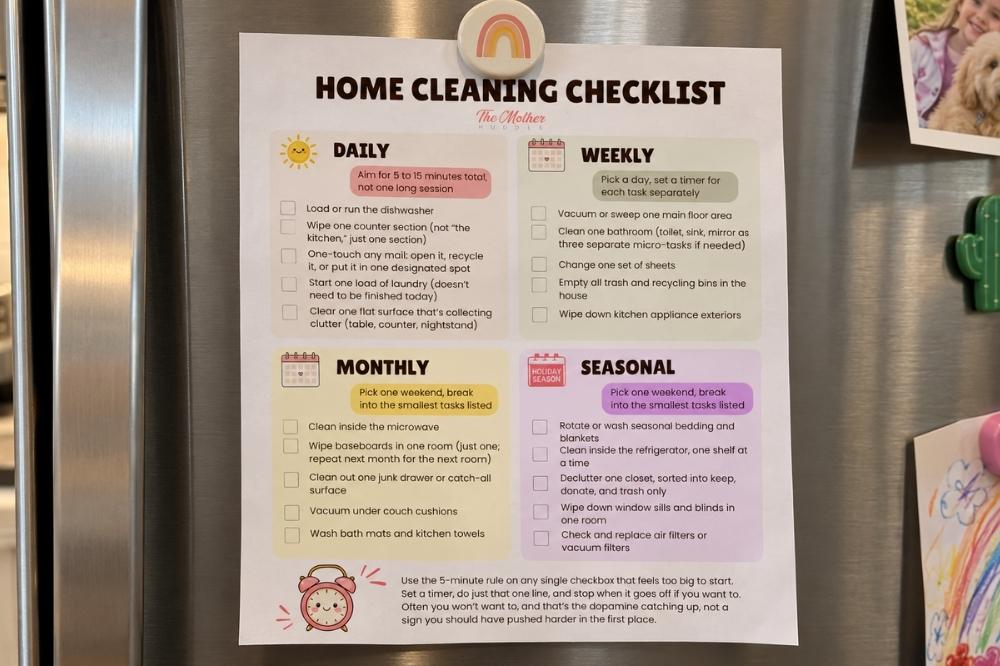
Here are tasks you can try on your own to make cleaning feel more manageable. You can also download the printable PDF and stick it on your refrigerator so your checklist is always easy to see and follow. Every task below is deliberately broken down into small, manageable steps with a clear finish line, rather than a vague category that can feel overwhelming.
Daily (aim for 5 to 15 minutes total, not one long session):
Load or run the dishwasher
Wipe one counter section (not “the kitchen,” just one section)
One-touch any mail: open it, recycle it, or put it in one designated spot
Start one load of laundry (doesn’t need to be finished today)
Clear one flat surface that’s collecting clutter (table, counter, nightstand)
Weekly (pick a day, set a timer for each task separately):
Vacuum or sweep one main floor area
Clean one bathroom (toilet, sink, mirror as three separate micro-tasks if needed)
Change one set of sheets
Empty all trash and recycling bins in the house
Wipe down kitchen appliance exteriors
Monthly: (pick one weekend, break into the smallest tasks listed)
Clean inside the microwave
Wipe baseboards in one room (just one; repeat next month for the next room)
Clean out one junk drawer or catch-all surface
Vacuum under couch cushions
Wash bath mats and kitchen towels
Seasonal (pick one weekend, break into the smallest tasks listed):
Rotate or wash seasonal bedding and blankets
Clean inside the refrigerator, one shelf at a time
Declutter one closet, sorted into keep, donate, and trash only (no “maybe” pile)
Wipe down window sills and blinds in one room
Check and replace air filters or vacuum filters
Use the 5-minute rule on any single checkbox that feels too big to start. Set a timer, do just that one line, and stop when it goes off if you want to. Often you won’t want to, and that’s the dopamine catching up, not a sign you should have pushed harder in the first place.
DOWNLOAD FREE HOME CLEANING CHECKLIST
This Isn’t About Trying Harder
The version of you who can’t get started on “cleaning the kitchen” is the same version who can absolutely load a dishwasher once it’s the only thing on the list. That’s not a contradiction or a character flaw; it’s exactly what executive dysfunction looks like in practice. The fix was never more willpower. It was breaking the task into pieces your brain can actually see the end of and giving yourself permission to stop after five minutes instead of requiring the whole project before it counts as progress.

Frequently Asked Questions
Why can I deep-clean everything before guests arrive but not maintain it day to day?
This is a dopamine-and-urgency pattern common in ADHD, not inconsistency. An external deadline provides the motivation that a routine task doesn’t generate on its own. Building in artificial urgency (a timer, a game, a body double) recreates some of that same effect for ordinary maintenance.
Does body doubling require the other person to help clean?
No. The strategy works through their presence alone, whether in person, on a phone call, or on video. They don’t need to do the same task or help at all; the external focus anchor is what matters.
Why do closed bins and drawers make my clutter worse instead of better?
Items that are out of sight are more likely to be forgotten entirely with ADHD, sometimes described as an object-permanence issue. Open, visible storage with clear labels tends to work better than fully closed systems for this reason.
How small should I break tasks down?
Smaller than feels necessary at first. If “clean the kitchen” has never worked, try “load the dishwasher” as a standalone task. You can always do the next micro-task once the first one is done, but a task with no visible starting point is the one most likely to stall before anything happens.